

When you meet new people at a party or a networking event, you inevitably get hit with that standard, boilerplate icebreaker: “So, what do you do?” I’ll admit, it feels pretty damn good to say, “I own a brewery.” Let’s just get that out there right now. It’s a genuinely fun industry filled with cool people, and at the end of the day, your primary objective is to make sure everyone walking through your doors is having a good time. It’s hard to complain about being in the business of selling joy in a pint glass.
The usual response from someone who has worked a corporate desk job their entire life is incredibly predictable. They usually lean back, sigh, and say, “Man, that’s awesome. I would love to do that someday. You’re living the dream.”
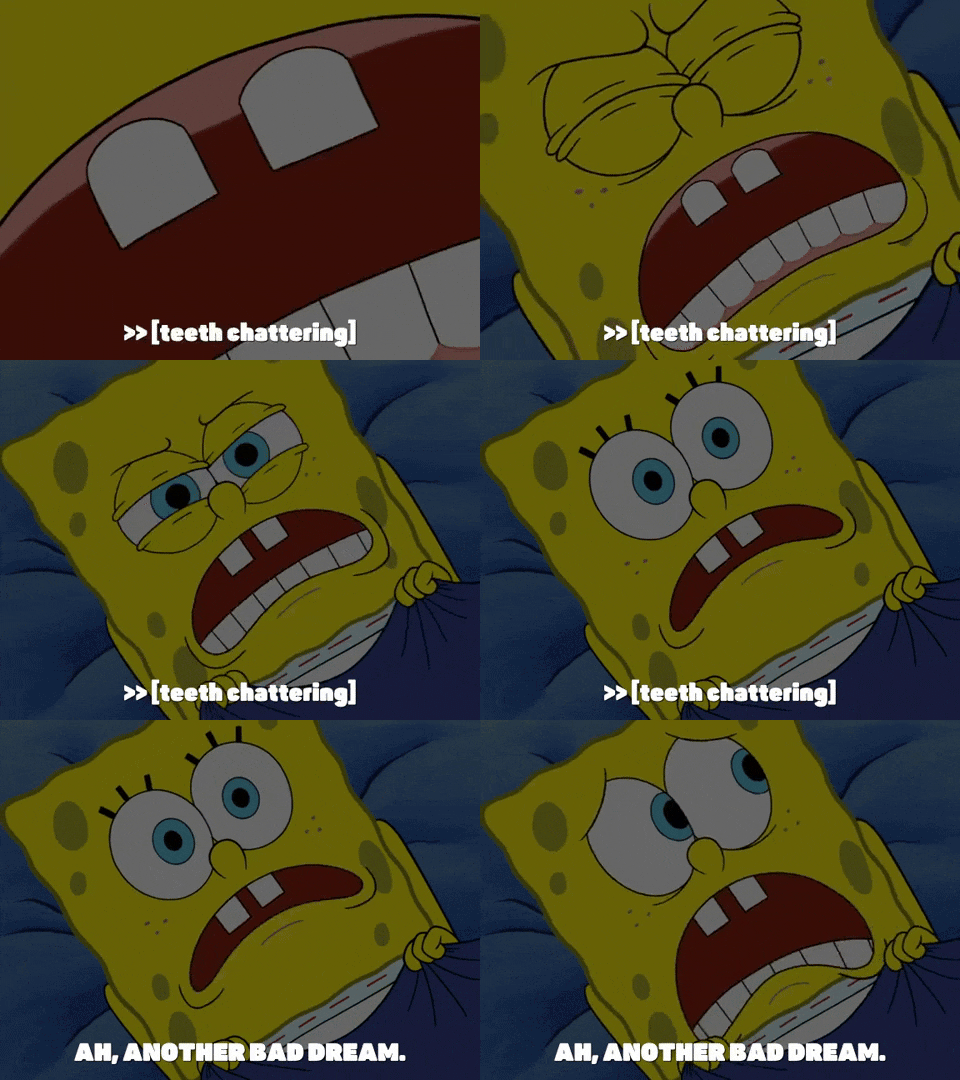
Here’s the thing they don’t tell you about living the dream: Nightmares are dreams, too.
The Treadmill of Success
In business, every step forward, every accomplishment, and every metric you hit doesn’t mean you get to coast. It just becomes a newly raised bar that you now have to clear again and again.
You brew a smash-hit IPA? Great, now your customers expect three more just like it next week. You hit your revenue target for the quarter? Fantastic. Now, do we reinvest that income? Which means you need more space, which means you need more staff. Sometimes you’re raising that bar for your customers, sometimes you’re raising it for your staff, and sometimes you’re just sadistically doing it to yourself.
That treadmill can be absolutely exhausting. You never really arrive; you just unlock the next, more complicated level of the game. To be clear, my business is super small. The model isn’t all that complicated. But that also means I am the “Director of Everything.”
Because I grew up in a family-owned business, I went into this with my eyes wide open. I knew most of the downsides of striking out on your own. People love the idea of “being your own boss.” Let me disabuse you of that notion right now. True, you might not have an actual human manager breathing down your neck, but make no mistake—you absolutely have a boss.
The business itself is your boss. Your customers are your boss. The inevitable reality of things breaking at the most inopportune times? That is the ultimate boss.
Don’t get me wrong. Probably 80% of the time, I absolutely love what I do. I love the flexibility it provides. Yes, the to-do list is a mile long and never truly finished, but in theory, I can usually tackle it when it works best for me and my family.
But it’s that other 20%—the dark, grueling, soul-sucking 20%—that the hustle-culture gurus conveniently leave out of their inspirational social media threads on entrepreneurship.
Risk, Ruin, and Rooftop HVACs
First, let’s talk about the risk. Pretty much anyone you’ve ever met who built a physical, brick-and-mortar business took a massive, stomach-churning financial risk at some point. You can study finance, analyze balance sheets, and model out cash flow projections until your eyes bleed, but a spreadsheet can’t prepare you for the reality of putting everything on the line.
There is a specific, metallic taste in your mouth when you realize your mortgage is directly tied to how much beer you sell on a rainy Tuesday in November. Personally, we essentially leveraged every single dollar we’ve ever made—including the equity in our home—just to get the brewery doors open. It was the ultimate illiquid bet.
And naturally, because the universe has a sick sense of humor, we found out my wife was pregnant exactly one month later. We’ll save the full panic attack of those specific stories for future episodes, but it’s crazy. It’s stupid. It is absolutely wrought with risk. Aside from a handful of second-generation, hand-me-down business owners (and frankly, even most of them), every single founder you know took that burden on in some form or fashion.
The next part of that shitty 20% is the mechanical failures. And let me tell you a secret about commercial equipment: it rarely breaks when you’re actually in the building. It’s as if these machines wait in the bushes, watching through the windows for you to drive away.
Currently, as I write this dispatch, one of my countertop canners is down, and my keg washer is refusing to cycle properly. Neither is a quick fix I can magically figure out with a wrench and a prayer. Both will require a trip somewhere else for specialized maintenance after I have already spent hours trying to be the shade tree mechanic. That trip has to be carved out of my already fully scheduled week. So, just as I thought I was finally coming up for air after drowning in end-of-the-year paperwork, I’m getting pounded right back below the surf by another wave of broken metal.
But that’s just a standard Tuesday. I once spent four agonizing months trying to run down a leak in one of our rooftop HVAC units that the actual professional repair guys—both roofers and HVAC technicians—could not figure out. Just me, a ladder, a flashlight, and a creeping sense of madness as water dripped onto the floor no matter what we patched.
The Unmodelable Human Element
You can build the most robust financial models in the world. You can forecast yeast attenuation and grain needs with pinpoint accuracy. But you cannot model the general public. There is no spreadsheet cell for the sheer, unadulterated chaos of human behavior.
There is no line item for the busy Friday night when a bartender accidentally hands a customer someone else’s credit card, letting them walk right out the door while the taproom is packed shoulder-to-shoulder. You can’t project the ROI of waking up to a deranged one-star review and a string of unhinged messages from someone promising to “end our business” when we had barely gotten off the ground. The vulnerability of pouring your heart into a business, only to have a complete stranger try to destroy it online for sport, is a uniquely modern kind of torture.
And then there are the phone calls. The “hey, sorry to bother you” texts that make your blood run cold. Like the time my bartender called to say they weren’t 100% sure, but they were pretty confident the guy at the end of the bar was casually doing cocaine. Or the time I was trying to sit down and eat a peaceful dinner, only to get interrupted because a regular customer suddenly lost their marbles and started screaming obscenities at the staff.
These are all real stories. I could go on literally forever.
The Panda Express Epiphany
There are millions of us out there who feel compelled—by a million different, irrational reasons—to build something for ourselves rather than clocking in for someone else. But being successful at it requires a level of white-knuckle intensity where you often kind of forget about yourself.
It can be incredibly lonely. It can be depressing. It is relentlessly hard.
Ironically, as I was scratching down notes for this piece, I was scarfing down my very first meal of the day. It was 3:15 PM. I was shoving lukewarm Chinese takeout into my face after racing out the door to go sit in the chaos of the school pickup line to get my son. And the fortune cookie at the bottom of the bag? It read:
“Make time for your passions.”
Like, thanks a ton, Panda Express.
It’s bad enough that this mediocre takeout is my first real sustenance of the day, but for dessert, I get a side of existential crisis. A passion? Other than work? I’d be thrilled just having enough time to get the “passion” of my business done, much less cultivating a hobby that didn’t just involve trying not to be a walking mound of goo by the time I turn 60, or finding ways to actually retire someday. Those are my hobbies now.
But that’s what we do. This is our passion. The grind, the risk, the broken keg washers, the unhinged Yelp reviews, the 3:15 PM lunches—it’s all part of the package.
If you own a business, good on you. I see you, and I feel your pain. If you’ve never had to experience that specific brand of joy, take a second and think about a friend of yours who has. They’ve probably been through the exact same wringer, waking up in the middle of the night wondering if the cooler is going to fail.
This shit ain’t easy. But it is the lifeblood of our economy and our local communities. These are the crazy people who sponsor your kid’s Little League team rather than spending that money on a nice weekend away. These are the businesses that happily donate gift cards for the high school drama club raffle, even when the canner is broken, the roof is leaking, and the margins are tight.
We all need to support them more.
Myself included.
Micro Brews, Macro Views
Dave
“You can study finance, analyze balance sheets, and model out cash flow projections until your eyes bleed, but a spreadsheet can’t prepare you for the reality of putting everything on the line.” Damn right, thanks for writing this 🫡