

Jeff Bezos sat down on CNBC Wednesday and dropped a soundbite designed to be aggregate-bait for the next month. I’ll take the bait. My wife asked me what I thought about this. Normally my wife’s eyes glaze over in 5 seconds when finance talk starts. So I sat up straight when she asked my thoughts on this issue.
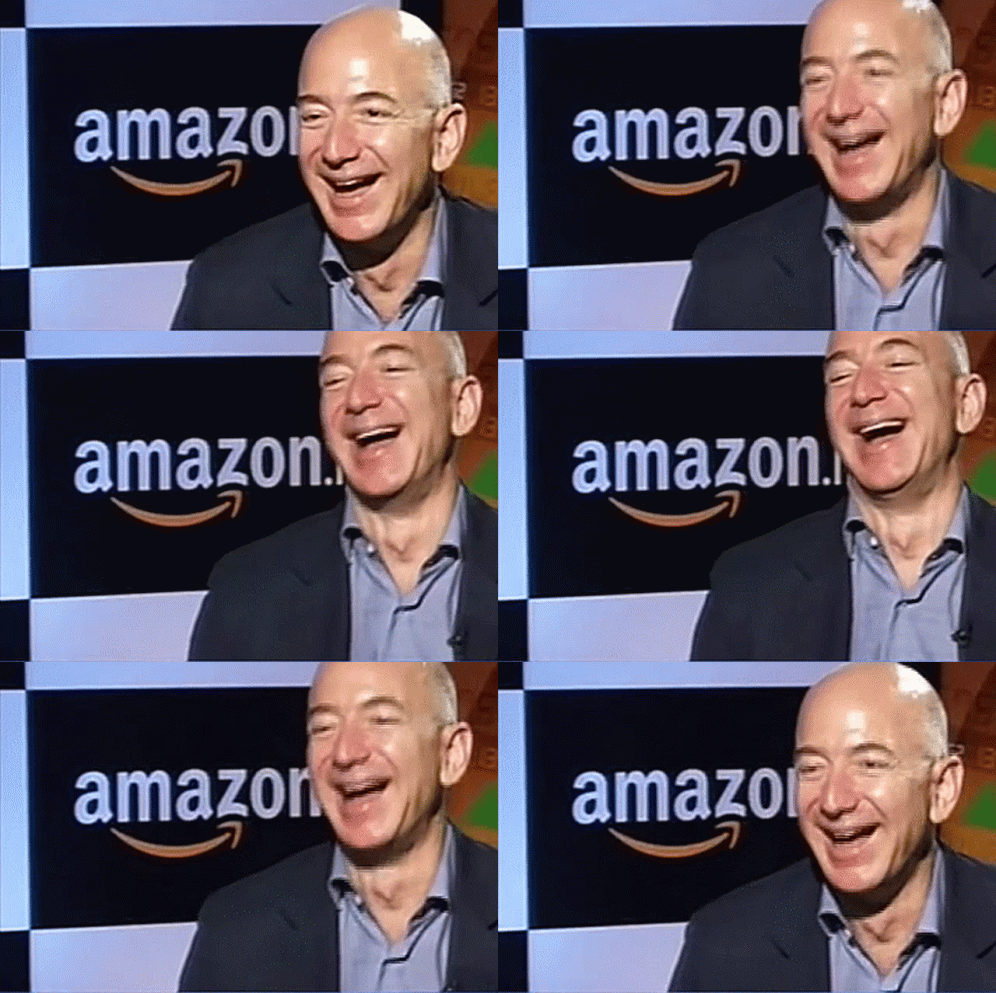
Bezos looked right into the camera and said the bottom half of American earners should pay exactly zero percent in federal income tax. Not a reduction. Not a tax credit. A flat, hard, absolute zero.
He gave this great, evocative example: Why are we asking a nurse in Queens making $75,000 a year to write a $12,000 check to Washington? We shouldn’t be taking her money, we should be sending her an apology.
It sounds incredible. It’s punchy, it’s populist, and if you’re that nurse in Queens, you’re nodding your head thinking, Finally, a guy at the top gets it.
But let’s step back from the studio lights for a second and look at how things actually work on the ground. Because when a guy worth over two hundred billion dollars starts talking about tax policy for the working class, you have to look at the game being played.
First of all, let’s stop using the word “billionaire.” It’s too clean. It’s a sterile, abstract word that hides the math. Let’s call a billionaires what they actually are: a thousand-millionaire.
Can you wrap your head around a million dollars? Sure. It’s a nice house in a good school district and a decent retirement. Now imagine one thousand of those people standing in a room. That is the baseline for a single billion. Jeff Bezos is worth over two hundred fifty thousand millionaires. When you frame it like that, the scale of that class is put in much better perspective.
So, when a thousand-millionaire starts advocating for the bottom 50% to pay zero taxes, we have to look at the economic reality of what he’s proposing.
We don’t have to guess what happens when you do this. We literally just ran this exact simulation a few years ago.
Back in 2022, my guy Josh Brown wrote an absolute banger of a post on The Reformed Broker called “You weren’t supposed to see that.” He was talking about the post-pandemic labor shift, but the core economic truth he hit on applies perfectly to Bezos’s tax fantasy.
Think back to the Covid stimulus. We ran the greatest economic experiment since the Great Depression. The federal government printed $4.3 trillion and dropped it onto the economy like candy being thrown at a parade. Direct payments, PPP loans, restaurant revitalization funds. Everyone’s bank account got a direct deposit, and for a brief moment, it felt like we’d cracked the code.
But what happened next? The exact thing that always happens when you try to shortcut the laws of economics.
When you eliminate federal income taxes for the bottom half of the country, you aren’t magically creating more houses, more cars, or more groceries. You are simply handing half the population an ongoing, permanent, infinite stimulus check. You get a massive surplus of capital instantly chasing a constrained supply of stuff.
High demand + flat supply = inflation on steroids.
A few years later, the market inevitably balances out—but it balances out at a much, much higher price point. Eggs are ten bucks. Rent has doubled. Your standard used car costs double what a new one did in 2019. Meanwhile, wages lag behind inflation, just like they always do.
The reality is that since the end of Bretton Woods taxes have not served as a way to fund the government. We all know the obvious that our government consistently spends more than it brings in. Taxes aren't just revenue; they're the brake that keeps the economic train from hitting runaway speeds.
So where does that leave everyone?
Right back where they started. The exact same people who were struggling before are still at the bottom, except now they’re drowning.
And the truly marginalized—the folks living below the poverty line who already paid zero federal income tax—become the walking dead of this economy. They didn’t get a single extra dollar from Bezos’s plan because they weren’t paying taxes to begin with. But now they’re completely priced out of the grocery store because the cost of basic food has tripled.
To top it all off, our now completely underfunded government looks at the wreckage and says, “Sorry, there’s nothing we can do to help you. We didn’t collect enough tax revenue.”
This doesn’t fix inequality. It exacerbates it on a dystopian scale.
This isn’t an argument against taxing thousand-millionaires much more—we absolutely should. But you can’t engineer a painless society from the bottom up by printing a “zero” on a tax form.
Josh laid this out perfectly in his piece, cutting right through the fairy tale of the “free market” to show how the system is actually designed:
“Look here, look there, look anywhere else. Just don’t look at the almost-liberated wage slaves being put back into their places. How dare you ask for more, how dare you expect more?”
The harsh reality is that capitalism is an adversarial game. For there to be winners, there have to be losers. The system is designed to have a bottom, and it can’t function without one. If everyone is “winning” because of an artificial cash flood, then no one is winning. The currency becomes worthless, and asset prices become meaningless.
Bezos’s proposal is a beautiful fantasy wrapped in a populist bow. But out here in the real world, the math always wins. And when the math wins, it’s never the thousand-millionaires who pay the price. It’s the nurse in Queens and the patients she provides care to.