

The Chart is Not the Churn
If you have clicked on any hacky local news reports about the beer industry, you probably walked away convinced that the beer industry is currently being loaded into a dumpster and set ablaze.
The headlines are relentless. They’ll tell you that Gen Z has abandoned the pint glass for legal cannabis and canned espresso martinis. They’ll show you data on the “Great Craft Shakeout”—the stories of regional pioneers selling off their shiny 30-barrel brewhouses for pennies on the dollar to satisfy a bank that stopped believing in the “craft dream”, and called their loan, somewhere around 2021.
When you’re standing in the trenches, or in the cold room as it were, it’s easy to catch the contagion. It feels like the “Gold Rush” isn’t just over; it feels like the mines have collapsed.
To see why the panic is so high, you only have to look at the “industry proxy.” In the world of finance, we look for a stock that represents the “mood” of a sector. For beer, that’s often $STZ Constellation Brands. The company that gobbled up craft breweries that were proudly independent, including the face melting acquisition of Ballast Point Brewing in 2015 for 1 billion freaking dollars. The sale that was was the spark that became the inferno of every mid-major craft brewer dreaming of a 10 figure buy out. Constellation sold Ballast Point for a mere 41 million only 4 years later.
Take a look at the five-year chart. It’s rough.
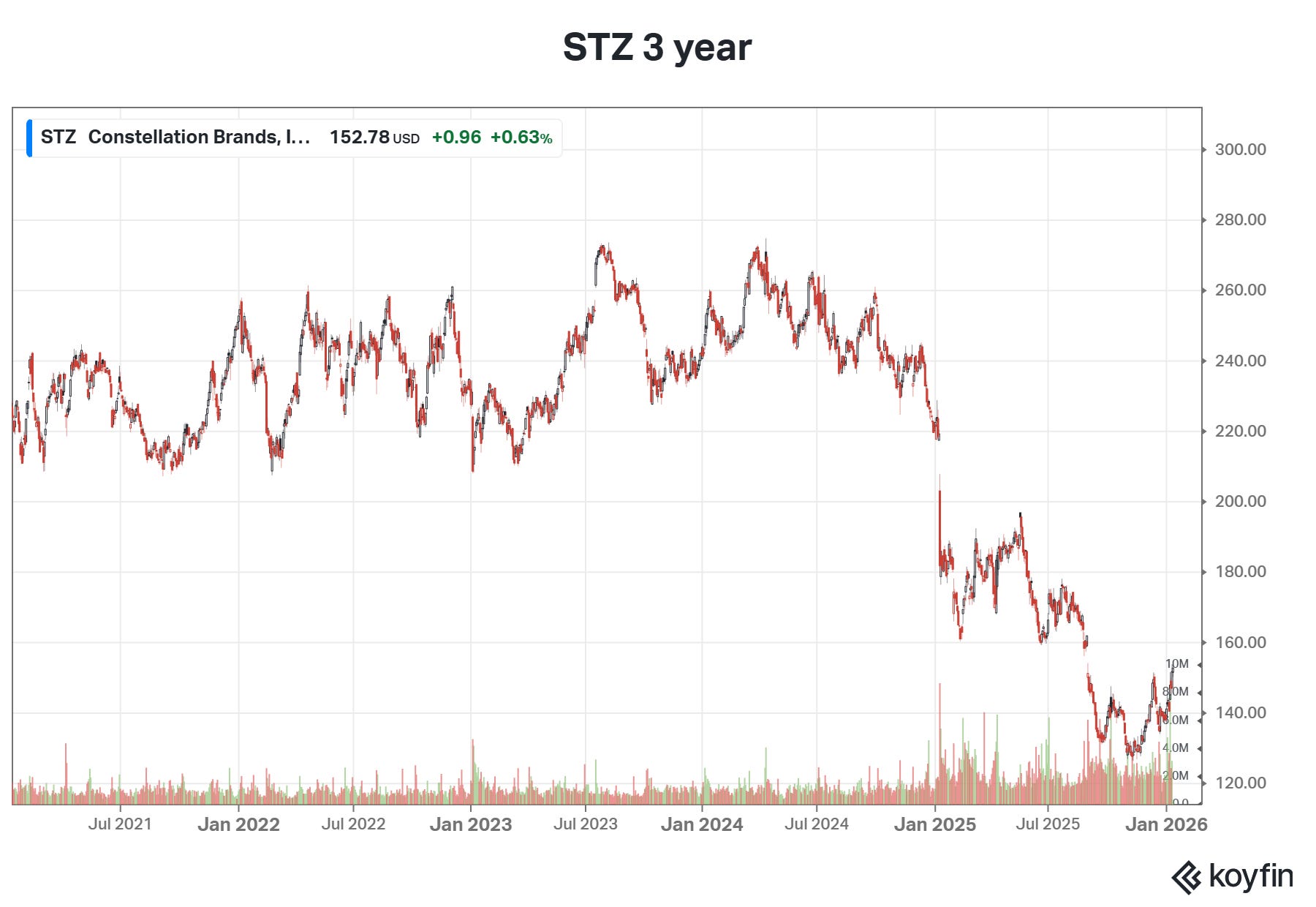
If you bought STZ in 2021 thinking the post-pandemic “Roaring Twenties” would last forever, you’re currently nursing a world-class hangover. From that perspective, the sky is absolutely falling. The growth has stalled, the “easy money” is gone, and the “vibes” are at an all-time low.
In the brewery world, this chart represents the “pothole” I talked about in my last post. It’s the sound of the door not swinging open as often as it used to. It’s the realization that the days of opening 1,000 breweries a year—a pace that defied every law of economic gravity—are officially dead and buried.
But there is a rule in the world of asset management that every small business owner should get to know:
When in doubt, zoom out.
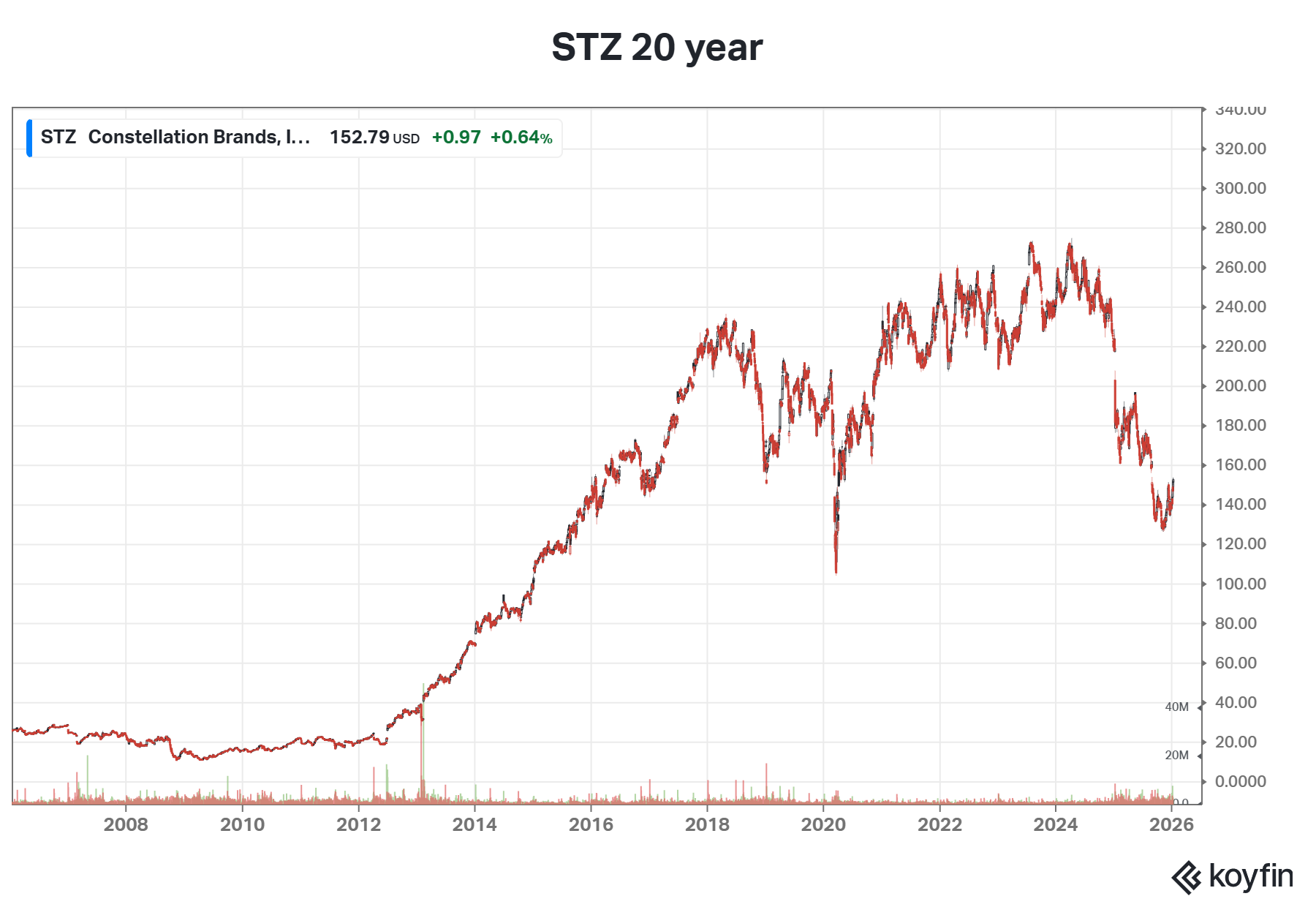
When you stop looking at the last five years of “market noise” and look at the last twenty years of “market reality,” the narrative changes instantly. I suppose you could call it lost decade… if you ignore the nearly 10x you got in the 4 years preceding that.
What we are witnessing isn’t an extinction event. It’s the brutal, necessary process of a market finding equilibrium.
Recency Bias is a Hell of a Drug
Financial often talks about (and then throws out the window) “Recency Bias”—the human tendency to believe that whatever happened lately is going to keep happening forever.
When the craft beer industry was growing at 15% a year and Constellation was minting money with the Modelo acquisition, everyone assumed the line would go to the moon. When the pullback hit, the bias flipped: now everyone assumes the line goes to zero.
But look at that 20-year chart again.
In 2005, there were roughly 1,400 breweries in the United States. Craft beer was a niche interest for people who liked to talk about IBUs and wear cargo shorts. Constellation Brands was trading at a split-adjusted price of around $15.
Fast forward to today. Even with the “shakeout” and the “dumpster fire” headlines, there are over 9,000 breweries. STZ is trading at nearly 15x its 2005 value.
The industry isn’t “dying.” It’s just no longer a startup.
If you bought a house in 2005 and it tripled in value, but then dropped 15% this year, you wouldn’t say your house is a “dumpster fire.” You’d say you’re still up significantly on your original investment and the market is cooling off.
The problem is that the “Micro” view of the brewery—the day-to-day grind of sales reports and ingredient costs—makes us hyper-sensitive to the 15% drop. We forget that the foundation of the industry is actually 10x stronger than it was when the revolution started.
We are suffering from a collective case of forgetting where we came from. We’ve had it so good for so long that a return to “level” feels like a catastrophe. But “level” is where the sustainable businesses are actually built.
The sky isn’t falling. The ceiling is just lower than it used to be.
The Gold Rush Fallacy
In the world of investing, there’s an old saying: “A rising tide lifts all boats.” Between 2012 and 2018, the tide in the craft beer world wasn’t just rising; it was a goddamn tsunami.
During that window, you didn’t need to be a financial wizard to run a successful brewery. You didn’t even necessarily need to be a great brewer. You just needed to be there. The demand was so ravenous that the “Gold Rush” felt permanent. We were opening 1,000 new breweries a year because the consumer’s appetite for “new” and “local” felt infinite.
But as Warren Buffett famously said, “Only when the tide goes out do you discover who has been swimming naked.”
The current “shakeout” isn’t a sign that the product is bad, or that customers all at once gave up on craft beer. It’s a sign that the business model of the Gold Rush era—the idea that you can scale indefinitely on hype alone—was a fallacy.
A lot of the breweries closing today aren’t victims of a dying market; they are victims of a maturing one. They are the businesses that over-leveraged when rates were near zero, or the ones that never learned how to manage a P&L because they never had to when the growth was 20% a year.
In finance, we call this “mean reversion.” After a period of extreme, unsustainable growth, things eventually return to the long-term average. It feels like a crash because we got used to the “too easy” era. But if you zoom out, this is just the industry professionalizing.
The “hobbyists” are being weeded out, and the “operators” are taking their place. Those who can survive this equilibrium—the ones with the sharp pencils and a long-term view—are going to inherit an industry that is still massively larger and more influential than anyone would have dreamed possible back in 2005.
The Gold Rush is over. The real work has finally started. The ones who were conservative during the boom and had a long-term sustainable plan will survive. Those that got stuck in the “dying middle” won’t.
Finding Our Level
It’s easy to get lost in the noise of a five-year correction. It’s a lot harder—but much more productive—to look at the twenty-year transformation of an entire culture.
The craft beer industry isn’t disappearing; it’s finally growing up. The era of “accidental success” has been replaced by an era that rewards discipline, data, and actually knowing your numbers. If you’re feeling the squeeze right now, it doesn’t mean the sky is falling. It means the floor has finally been set.
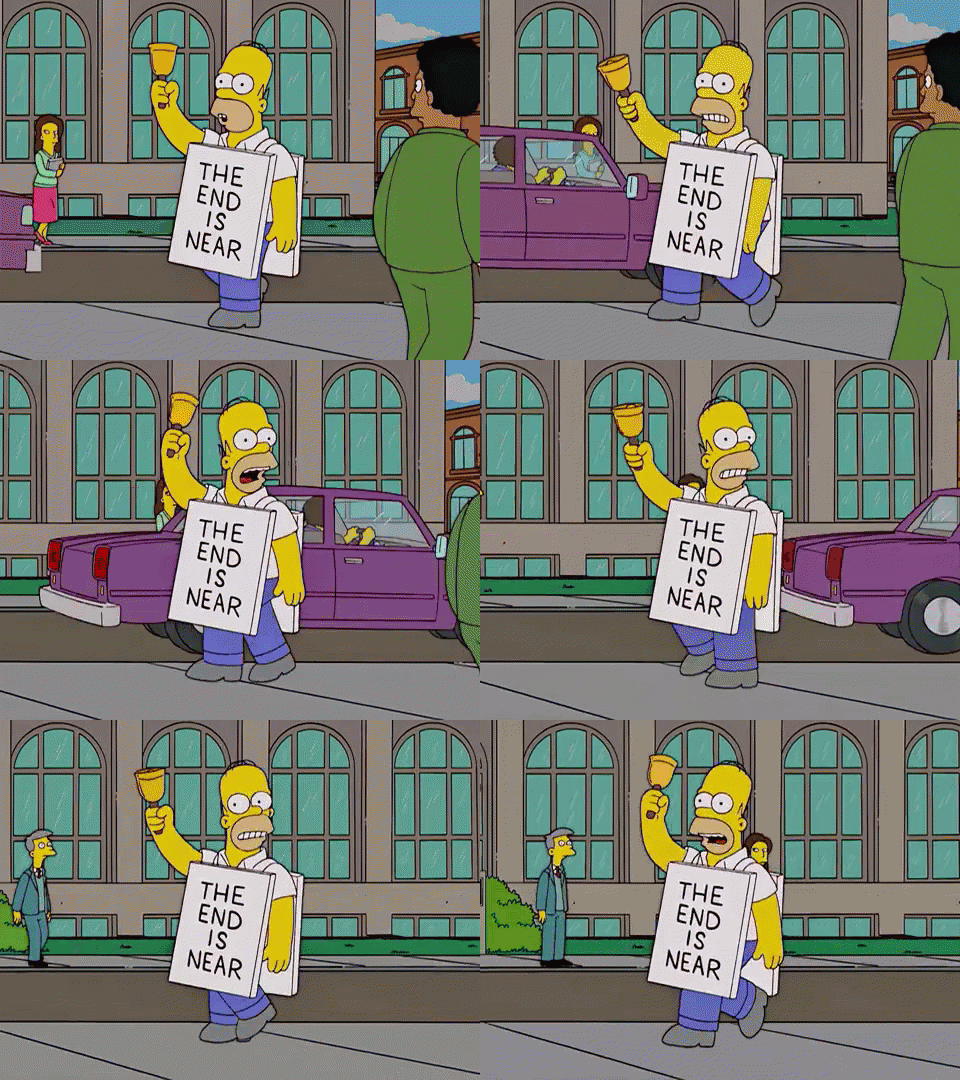
I belong to a Facebook beer group where the news of another brewery closing has become a weekly ritual. Every time it happens, my contribution to the thread is usually a GIF of Homer Simpson wearing an “The End is Near” sandwich board. It’s (mostly) tongue-in-cheek. But the next time you see a headline predicting the collapse of the industry, take a breath and look at the long-term trend. The market is finding its level, and for the operators who are paying attention, the foundation is stronger than it’s ever been. Not to say that can’t and won’t change. But for now, the big picture of the past 20 years looks pretty good.
Micro Brews and Macro Views,
Dave
I tell people this almost every weekend when they ask me why so many breweries are closing. I tell them the good breweries are going to struggle, but survive. We are getting closer to a craft beer scene full of breweries that care about quality, consistency, and atmosphere.